
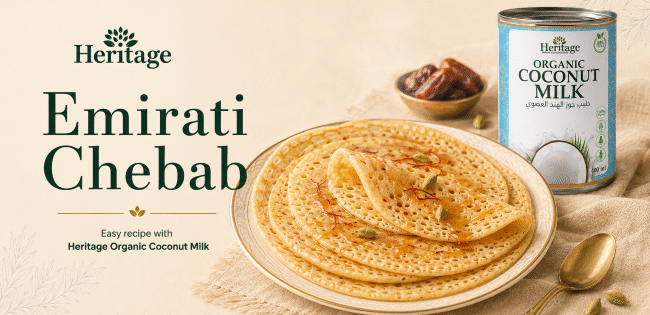
Soft, fragrant and beautifully golden, this Emirati Chebab recipe combines the familiar flavours of saffron and cardamom with the creamy richness of Heritage Organic Coconut Milk.
The result is a tender, flexible pancake with the signature porous surface that absorbs every drop of date syrup, honey or table cream.
Chebab is one of the UAE’s most comforting breakfast dishes. It is often enjoyed during family gatherings, Ramadan mornings and Eid celebrations, but it is equally welcome during a relaxed weekend breakfast.
Unlike a thick American-style pancake, Chebab is thinner, yeast-raised and dotted with small holes. Its texture sits somewhere between a pancake and a soft, rollable flatbread.
This version keeps the warm spice profile that makes Chebab distinctive while replacing most of the traditional liquid with coconut milk. Heritage Organic Coconut Milk adds a smooth mouthfeel and gentle coconut note without overpowering the saffron or cardamom.
This is a coconut milk adaptation of Emirati Chebab. Keep the coconut milk at room temperature and use warm—not hot—water so the yeast can activate properly.
What Is Emirati Chebab?
Chebab, sometimes written as Chabab, is a traditional Gulf pancake strongly associated with Emirati cuisine.
The batter is loose enough to spread naturally in the pan, yet it remains thicker than crêpe batter. Yeast produces the tiny bubbles and characteristic holes that appear across the surface as the pancake cooks.
Saffron lends Chebab its beautiful golden tone and delicate floral aroma, while cardamom adds a warm, citrusy spice.
Freshly cooked Chebab is commonly brushed with ghee or butter and served with date syrup, honey, jam or table cream.
Why Use Coconut Milk in Chebab?
Coconut milk works especially well in this Emirati Chebab recipe because it adds richness without making the pancakes heavy.
It also complements saffron, cardamom and dates—flavours already familiar across the Gulf.
Heritage Organic Coconut Milk creates a softer bite, helps the pancakes stay moist and gives the batter a subtle natural sweetness.
Emirati Chebab Recipe at a Glance
Prep time: 10 minutes
Batter resting time: 1 hour
Cooking time: 20 minutes
Total time: 1 hour 30 minutes
Yield: 6 pancakes
Cuisine: Emirati / Arabian
Course: Breakfast or dessert
Diet: Vegetarian
Ingredients
- 1 cup all-purpose flour
- 1 large egg, at room temperature
- 2 tablespoons sugar
- 1 cup Heritage Organic Coconut Milk, at room temperature
- 3 tablespoons warm water
- ½ teaspoon active dry yeast
- ½ teaspoon ground cardamom
- ½ teaspoon saffron threads, lightly crushed
- Ghee or unsalted butter, for brushing
- Date syrup, honey or table cream, for serving
Consistency note: Coconut milk thickness can vary. The finished batter should pour easily and spread by itself. If it is too thick, whisk in one tablespoon of warm water at a time.
How to Make Emirati Chebab with Coconut Milk
1. Activate the Yeast and Aromatics
Add the warm water, sugar, active dry yeast, ground cardamom and saffron to a large mixing bowl.
Whisk until the ingredients are combined. Let the mixture stand for approximately five minutes so the saffron begins releasing its colour and the yeast starts to activate.
The water should feel comfortably warm rather than hot. Water that is too hot can damage the yeast.
2. Add the Coconut Milk and Egg
Pour the room-temperature Heritage Organic Coconut Milk into the yeast mixture.
Add the egg and whisk until the mixture becomes smooth and evenly coloured.
Using room-temperature coconut milk and egg helps the yeast remain active and encourages a better rise.
3. Whisk in the Flour
Add the flour gradually while whisking.
Continue whisking until there are no dry pockets or large lumps. The finished batter should be pourable—thicker than crêpe batter but looser than standard pancake batter.
If the batter looks too thick, add a little extra warm water. Add only one tablespoon at a time so the mixture does not become watery.
4. Rest the Batter
Cover the bowl with a clean kitchen towel, reusable cover or food-safe wrap.
Leave the batter in a warm place for approximately one hour, or until the surface looks lively and bubbly.
This resting time is essential. It allows the yeast to create the bubbles responsible for Chebab’s characteristic porous surface and soft texture.
5. Heat the Pan
Place a good-quality non-stick frying pan over high heat.
Allow the pan to become properly hot before adding the first portion of batter.
Briefly and gently stir the rested batter to redistribute the saffron and cardamom. Avoid whisking aggressively because you do not want to remove all the air created during resting.
6. Pour the Batter
Pour approximately ⅓ cup of batter into the centre of the hot pan.
Allow the batter to spread naturally, then reduce the heat to medium.
Avoid swirling the pan too aggressively. Letting the batter spread naturally gives Chebab its characteristic thickness and circular shape.
7. Brush and Flip
Cook until the top has no wet patches and is covered with many small holes.
Lightly brush the surface with melted ghee or unsalted butter.
Carefully slide a thin spatula underneath the Chebab and flip it. Cook the second side until it becomes lightly golden.
The pancake should remain soft and flexible. Do not cook it until it becomes dry or crispy.
8. Keep the Chebab Covered
Flip the Chebab once more for a few seconds, then transfer it to a serving plate.
Cover the cooked pancakes with a clean kitchen towel while you finish the remaining batter. Keeping them covered traps a small amount of steam and prevents the edges from becoming dry.
Expert Tips for Soft, Porous Chebab
Use Warm Water
Use comfortably warm water rather than boiling water. Excessive heat can damage the yeast and prevent the batter from rising correctly.
Bring Ingredients to Room Temperature
Bring the coconut milk and egg to room temperature before mixing. Very cold ingredients can slow the yeast and increase the required resting time.
Start with a Hot Pan
The pan should be properly heated before the batter is poured. The initial burst of heat encourages more holes to form across the Chebab’s surface.
Reduce the heat after the batter has spread so the pancake cooks evenly without burning.
Use a Non-Stick Pan
Chebab is delicate before the surface is completely set. A good non-stick pan and thin spatula make flipping easier and help prevent tearing.
Measure Each Portion
Keep each portion close to ⅓ cup. Adding too much batter creates a thick centre that may remain undercooked.
Brush with Ghee While Hot
Lightly brushing the Chebab with ghee or butter gives it a beautiful shine, deeper flavour and softer texture.
Avoid using too much ghee because it can make the pancakes greasy.
Cover the Cooked Pancakes
Cover each cooked Chebab immediately. Leaving the pancakes uncovered allows steam to escape and may make the edges dry.
How to Serve Emirati Chebab
Serve Chebab warm, either stacked or folded into quarters.
For a distinctly Emirati presentation, drizzle the pancakes with date syrup and add a small spoonful of table cream on the side.
Honey is another excellent choice, particularly when paired with a light sprinkle of ground cardamom or crushed pistachios.
For a larger UAE-inspired breakfast spread, serve Chebab with fresh dates, seasonal fruit, Arabic coffee or karak tea.
The soft pancakes can also be rolled around a thin layer of honey, jam or chocolate-hazelnut spread for a family-friendly variation.
Serving Ideas
- Date syrup, saffron threads and a light brush of ghee
- Honey with crushed pistachios or toasted almonds
- Table cream with fresh dates
- Jam or chocolate-hazelnut spread
- Fresh berries or sliced banana
- Arabic coffee or karak tea
- A small bowl of fresh seasonal fruit
How to Store Leftover Chebab
Allow leftover Chebab to cool completely.
Place the pancakes in an airtight container with parchment paper between each layer. Refrigerate them for up to three days.
To reheat, place an individual Chebab in the microwave for 15 to 20 seconds. You can also warm it briefly in a covered pan over low heat.
Brush the reheated pancake with a small amount of ghee or butter to restore its soft finish.
Can You Freeze Chebab?
Yes. Allow the cooked pancakes to cool completely before freezing.
Arrange them in a single layer and freeze until firm. Transfer the frozen pancakes to a freezer-safe container or resealable bag, placing parchment paper between the layers.
Reheat the Chebab directly from frozen in the microwave, or allow it to thaw overnight in the refrigerator.
Frequently Asked Questions
Can I Make Chebab Entirely with Coconut Milk?
Yes. This recipe uses Heritage Organic Coconut Milk as the main liquid, with a small amount of warm water to activate the yeast and keep the batter pourable.
If your coconut milk is especially thick, add a little extra warm water until the batter reaches the correct consistency.
Why Does Chebab Have Holes on the Surface?
The holes are created by active yeast and a properly heated pan.
Resting the batter gives the yeast time to produce bubbles. The initial high heat helps those bubbles open across the surface when the batter reaches the pan.
Can I Prepare the Batter in Advance?
For the best rise and texture, cook the batter after its one-hour resting period.
If necessary, refrigerate the covered batter for up to 24 hours. Let it sit briefly at room temperature and stir it gently before cooking.
Can I Make Chebab Without Saffron?
Yes, but the flavour and colour will be less traditional.
Cardamom alone still produces a fragrant pancake. You can also add a small amount of vanilla or lemon zest for a different variation.
Is This Chebab Recipe Gluten-Free?
No. This recipe uses all-purpose wheat flour.
A gluten-free all-purpose flour blend may work, but the texture and spread can differ. Add the warm water gradually and adjust the batter as needed.
What Is the Best Pan for Chebab?
A flat, good-quality non-stick frying pan is the easiest choice.
It helps the delicate pancake release cleanly and makes flipping safer.
What Should Chebab Batter Look Like?
The batter should pour in a steady ribbon and spread on its own when it reaches the hot pan.
It should be thinner than standard pancake batter but not as watery as crêpe batter.
Why Is My Chebab Not Forming Holes?
The batter may not have rested long enough, the yeast may be inactive or the pan may not be hot enough.
Make sure your yeast is fresh, use warm water and allow the batter to rest until bubbles appear across the surface.
The pan should be properly heated before adding the batter.
Can I Replace Ghee with Butter?
Yes. Unsalted butter can be used instead of ghee.
Ghee provides a slightly richer, more traditional flavour, but both options will help keep the Chebab soft and give it an attractive shine.
A UAE Breakfast Favourite with a Heritage Twist
This Emirati Chebab recipe brings together the gentle sweetness of coconut milk, the floral aroma of saffron and the unmistakable warmth of cardamom.
With a proper resting period and a hot non-stick pan, the batter cooks into soft, golden pancakes filled with tiny holes—perfect for catching date syrup or honey.
Keep a can of Heritage Organic Coconut Milk ready for your next family breakfast and enjoy a creamy new take on a much-loved UAE classic.
Save this recipe for later, share it with someone who loves Emirati food and discover more coconut-inspired recipes from Heritage Organic.